
Product Design · Healthcare · Henry Ford Innovations
StatChat
A HIPAA-compliant care-team messaging app that replaced pagers and hallway handoffs with a patient-centered feed. Born at Henry Ford Innovations as StatChat, piloted at Henry Ford Health System, and launched commercially in 2017 as CareTrail with VisionIT and Microsoft.

At a glance
- Problem
- Surgical teams coordinated through overhead pages, whiteboards and hallway handoffs, with no record of who got a message, read it, or acted on it.
- Users
- OR nurses, anesthesiologists, surgeons and residents working across the surgical day.
- My role
- Led UX research and design: contextual inquiry with OR nurses, surgeons and anesthesiologists, information architecture, interaction design and product strategy over three years, through handoff to engineering for development.
- Outcome
- Piloted at Henry Ford Health System, then launched in 2017 as CareTrail, a commercial product built with VisionIT on Microsoft Azure and first demoed at HIMSS 2017.
The Challenge
Surgical teams relied on overhead paging, dry-erase boards and hallway handoffs to coordinate patient care. When a patient moved from pre-op to the OR, the people who needed to know often didn't, and there was no record that anyone had received a message, let alone acted on it. The cost of that gap wasn't inconvenience. It was patient safety.
Pages can't prove receipt
An overhead page or a pager buzz leaves no trace of who heard it, read it or responded.
Patient data lives in silos
Status was split across Sisweb, Central Scheduling and Epic, with no single view of where a patient was.
Handoffs happen in hallways
Updates moved person to person, so anyone who missed the conversation missed the update.
Research & Contextual Inquiry
I ran contextual inquiry with OR nurses, surgeons and anesthesiologists, observing and interviewing them in the flow of the surgical day. HIPAA compliance was non-negotiable. Four findings shaped everything that followed.
No shared language
Pre-op, anesthesia and surgery each described a patient's progress differently, so status updates were open to interpretation.
Systems don't talk
Patient data was fragmented across Sisweb, Central Scheduling and Epic. No one role had the whole picture.
Coverage can't lapse
Teams needed a structural guarantee that at least one provider is always reachable: the Last Man Standing rule.
"Read" isn't enough
A legally defensible record had to distinguish Delivered, Read, Acknowledged and Acted Upon.
Key Design Decisions
I built the communication model around four decisions, each trading open-ended flexibility for clarity and accountability. Thirteen OR trigger states, from In Facility through Procedural Care Complete, gave the whole team one timestamped language for the surgical day.
Organize around the patient
Every message lives on a patient's feed, not in a private thread, so anyone joining the case sees the full timestamped history.
Three urgency tiers
Low posts silently, Normal sends a push, High alerts immediately with sound. Reserving sound for High keeps alerts meaningful.
Short, templated messages
A 90–110 character limit and role-based phrases for Pre-Op, Anesthesia and Surgery keep updates scannable and sendable in seconds.
Accountability by design
Four receipt states and the Last Man Standing rule are enforced by the app, not left to etiquette.
The system
- OR trigger states
- 13
- Urgency tiers
- 3
- Receipt states
- 4
- Character max
- 110


Physician workflow: a morning in General Surgery
Iteration: Sketches → v1 → v4
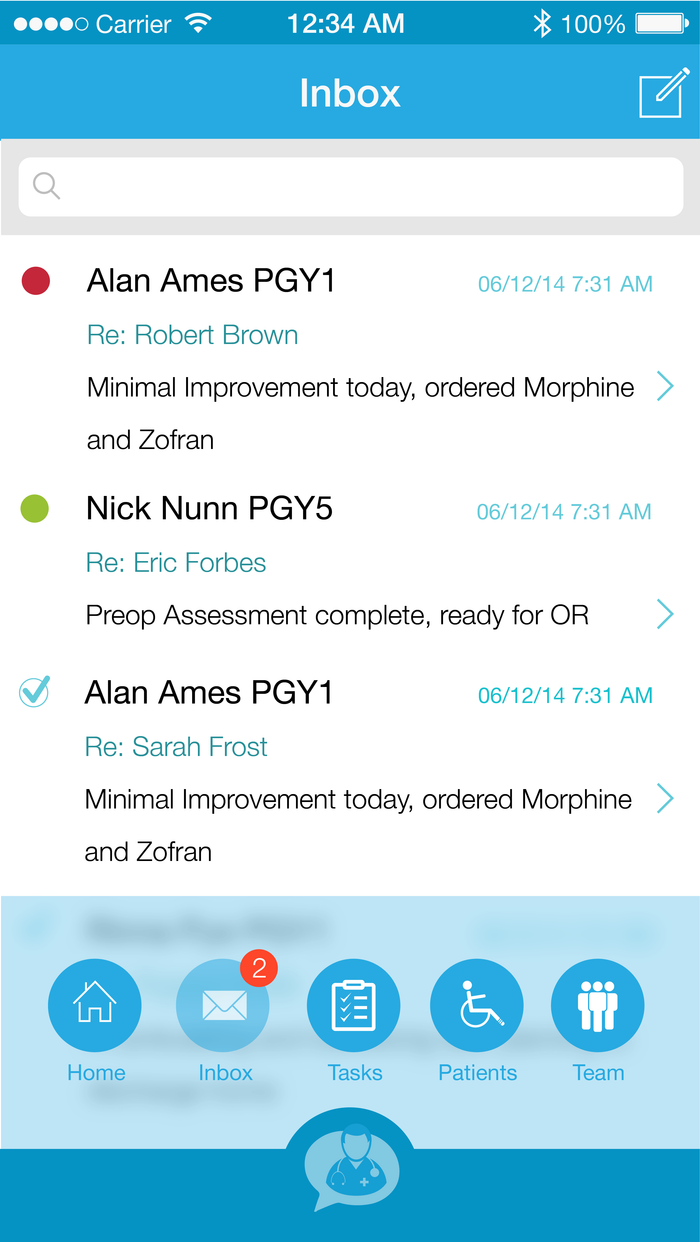
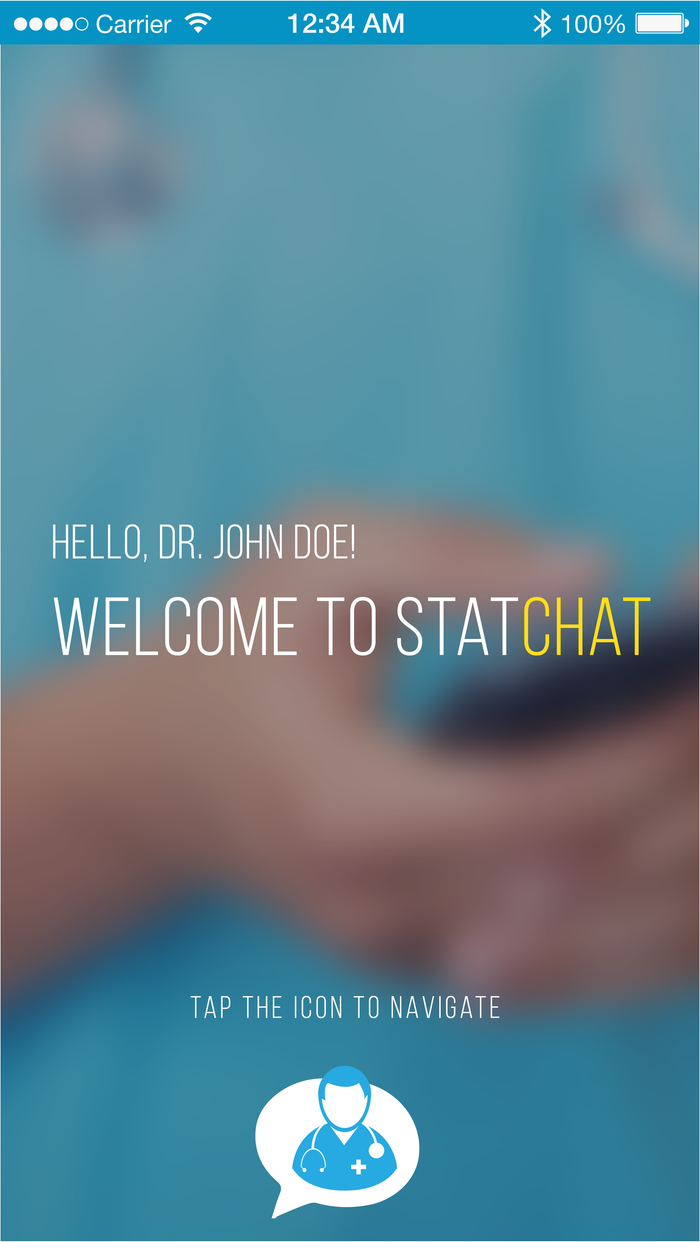
I moved from whiteboard flows to annotated paper wireframes, then to a functional v1 built around Henry Ford's workflows. v1 proved the model but packed patients, recipients and priority onto dense, table-style screens. v4 split the app into focused tabs (Inbox, Tasks, Patients and Team) with larger touch targets and clear availability icons.


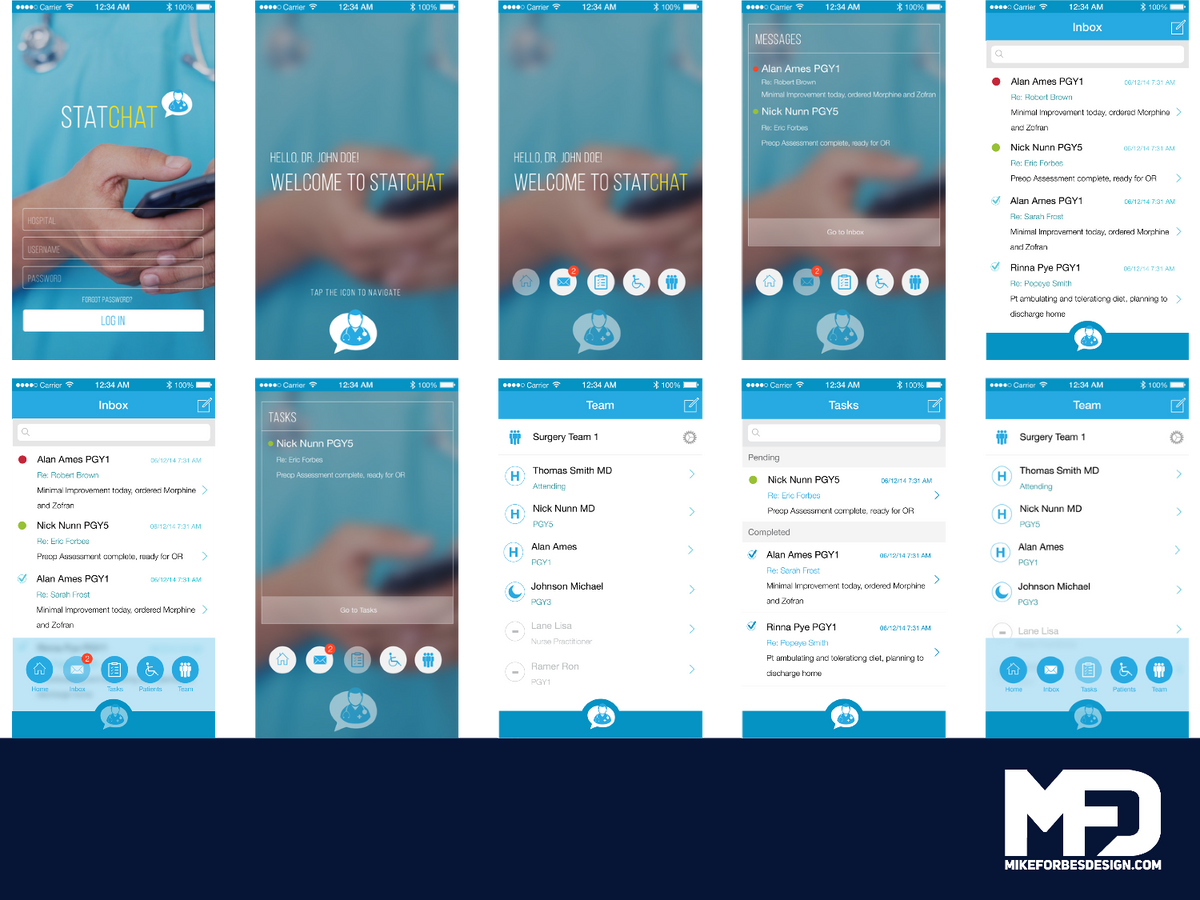

Key screen wireframes: physician workflow
Final Design
The v4 system keeps every screen to one job: see what changed, act on it, and know who is covering.


Try the Prototype
Send a message at each priority, advance a patient through the OR states, and test the Last Man Standing rule. Every action lands in the audit trail.
Tap a status to change it.
Last Man Standing
From StatChat to CareTrail
StatChat was piloted with clinical teams at Henry Ford Health System. In February 2017, Henry Ford Innovations and VisionIT launched it commercially as CareTrail, hosted on Microsoft Azure and first demonstrated in Microsoft's booth at HIMSS 2017. The core model carried through: a dedicated page for every patient, secure real-time messaging from any device, and on-call scheduling that shows who on the team is available.
Read the 2017 CareTrail announcementPatient pages
Each patient gets a dedicated page where the team's secure conversation lives: the patient-centered feed at the heart of StatChat.
On-call visibility
On-call scheduling shows which care team members are available, the coverage problem Last Man Standing set out to solve.
Extended care teams
Clinicians can securely invite outside medical professionals into a patient's care team.
Built to scale
Hosted on Microsoft Azure, designed to connect with most EHRs, and offered to any hospital, homecare agency or medical group.